Key Takeaways
- Jasper and Copy.ai still lead the pack for marketing teams, but the gap between them and newer tools like Writesonic has shrunk dramatically in the past year.
- Free tiers are getting more generous. Compose AI and Slick Write offer solid functionality at zero cost — enough for solo marketers or small teams on tight budgets.
- No AI writing tool replaces editing. Every tool we tested produced at least some output that needed human revision for accuracy, tone, or just plain weirdness.
- Your choice should depend on content type. A tool that crushes ad copy might be mediocre for long-form blog posts. We built a Content-Fit Matrix below to help you match tools to tasks.
- Budget between $29–$99/month for a tool that covers most marketing writing needs. Anything above that should come with team features and workflow automation.
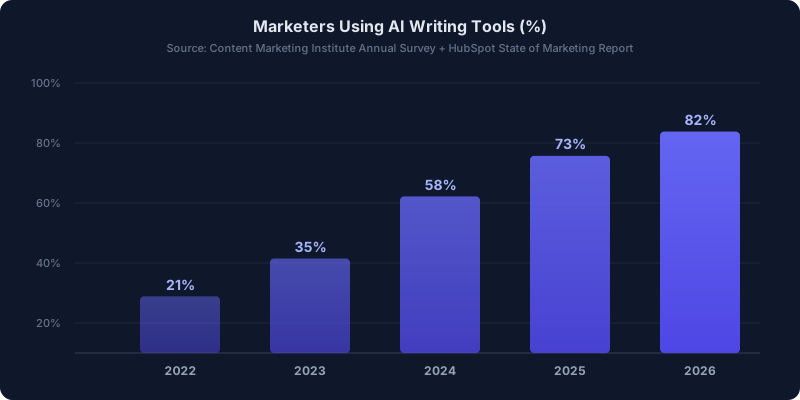
Eighty-two percent of marketers now use some form of AI writing tool. That number was 21% back in 2022. If you're reading this, you're probably either shopping for your first tool or wondering whether the one you're paying for is actually the best fit.
We spent six weeks testing over 30 AI writing tools. Not just kicking the tires — actually running them through real campaign workflows. Blog drafts. Email sequences. Google Ads headlines. LinkedIn posts that don't make people cringe. The whole spread.
Some tools blew us away. Others? Overhyped and underwhelming. Here's what we found.
The 10 Best AI Writing Tools for Marketers in 2026
Before we get into the detailed reviews, here's a side-by-side look at all ten tools. Pricing reflects plans current as of February 2026 — these change frequently, so double-check before you buy.
| Tool | Best For | Starting Price | Free Tier? | Key Strength |
|---|---|---|---|---|
| Jasper | Full marketing teams | $49/mo | 7-day trial | Brand voice control & campaign workflows |
| Copy.ai | Sales & GTM teams | $36/mo | Yes (2,000 words/mo) | Workflow automation with AI chat |
| Writesonic | SEO-focused content | $16/mo | Yes (limited) | Built-in SEO scoring & Surfer integration |
| Grammarly | Editing & consistency | $12/mo | Yes (basic checks) | Real-time tone and correctness across apps |
| Wordtune | Rewriting & rephrasing | $9.99/mo | Yes (10 rewrites/day) | Sentence-level rewrites that actually read well |
| Peppertype | Content marketing ops | $35/mo | Trial only | End-to-end content workflow platform |
| Copymatic | High-volume copy | $19/mo | Yes (1,000 words/mo) | Bulk generation with decent quality |
| Moonbeam | Long-form blog posts | $29/mo | Trial only | Guided outlining & structured long-form drafts |
| Compose AI | Faster everyday writing | Free | Yes (full) | Chrome autocomplete that's surprisingly useful |
| Slick Write | Readability analysis | Free | Yes (full) | Detailed readability & style metrics |
Top 5 Tools: In-Depth Reviews
1. Jasper — The Workhorse for Bigger Marketing Teams
Jasper's been around since 2021 (back when it was called Jarvis), and it's matured into something genuinely useful for teams. Not just solo writers — actual teams with brand guidelines, approval chains, and content calendars.
The standout feature is Brand Voice. You feed Jasper your style guide, example content, and tone preferences, and it actually learns how your company sounds. We uploaded about 15 blog posts and a few landing pages from a B2B SaaS client, and the output was noticeably closer to their voice than any other tool we tested. Not perfect. But close enough that editing took 20 minutes instead of an hour.
Jasper's campaign feature is where things get interesting for marketers running multi-channel pushes. You describe a campaign once — audience, offer, goals — and it generates drafts across blog, email, social, and ads. The social posts were usable almost as-is. The blog drafts needed work, but the structures were solid.
Here's the deal: at $49/month for the Creator plan (and $125/month for Teams), Jasper isn't cheap. If you're a solo freelancer writing three blog posts a month, it's probably overkill. But for a marketing team producing 20+ pieces a week across channels? It pulls its weight.
What we didn't love: The template library feels bloated. There are 50+ templates and maybe 15 of them are actually useful for modern marketing. Also, the AI occasionally produces confident-sounding claims with no basis — you absolutely must fact-check everything.
2. Copy.ai — Best for Sales-Led Marketing Teams
Copy.ai has pivoted hard toward go-to-market workflows, and honestly, it's working. The tool now feels less like a generic writing assistant and more like a GTM operations platform that happens to produce copy.
The workflow builder is the real star. You can set up automated sequences: pull prospect data, generate personalized outreach emails, draft follow-ups, and create matching LinkedIn messages. We ran a test sequence targeting 50 fictional prospects, and the personalization was surprisingly good. Not "clearly a mail merge" good — actually tailored to each company's recent news and pain points.
For pure copywriting, Copy.ai handles short-form content better than long-form. Product descriptions, email subject lines, social captions — these come out sharp and usually need minimal editing. Blog posts are another story. They tend to be structurally fine but tonally bland. You'll spend time injecting personality.
The free tier gives you 2,000 words per month, which is enough to decide if it fits your workflow. The $36/month plan removes limits and adds the workflow features that make Copy.ai worth paying for.
Our take: If your marketing is tightly coupled with sales (think ABM, outbound campaigns, product launches), Copy.ai is hard to beat. If you're primarily a content marketing team focused on SEO blog posts, look at Writesonic instead.
3. Writesonic — The Budget-Friendly SEO Powerhouse
This one surprised us. At $16/month, Writesonic doesn't have the brand cachet of Jasper or Copy.ai, but for SEO-driven content marketing, it punches above its weight. Significantly.
The built-in SEO features are what set it apart. Writesonic scores your content against target keywords in real time, suggests related terms, and integrates with Surfer SEO if you're already paying for that. We generated a 2,000-word blog post targeting "project management software for agencies" and the first draft scored 74/100 on content optimization without any manual keyword stuffing. After 15 minutes of editing, we hit 89.
Writesonic also ships with an AI chatbot builder (Botsonic) and a brand voice feature, though neither is as polished as dedicated solutions. The chatbot is useful for simple FAQ-style bots on your website. The brand voice works but needs more examples than Jasper's to lock in your tone.
Quality-wise, the writing skews slightly more "AI-sounding" than Jasper's output. You'll notice more generic transitions and safe word choices. But for teams that prioritize volume and SEO performance over literary polish, that trade-off might be perfectly fine.
Bottom line: Best value for money if SEO content is your primary focus. Check out our best AI SEO tools roundup for more options in this space.
4. Grammarly — Still the Undisputed Editing Layer
Grammarly is a different animal than the other tools on this list. It's not trying to generate content from scratch — it's trying to make your content (or your AI-generated content) better. And it's still the best at that job.
Grammarly's generative features have expanded a lot since the GrammarlyGO launch. You can now rewrite entire paragraphs, adjust tone, and even generate short drafts within the app. But let's be real: you're paying for Grammarly because of the editing, not the generation.
The tone detector is genuinely useful for marketing teams. Upload your brand guidelines, set target tones per content type, and Grammarly flags anything that drifts. We set up profiles for "casual blog voice" and "formal product announcement" and the suggestions were spot-on about 80% of the time.
What makes Grammarly indispensable is that it works everywhere. Gmail, Google Docs, Notion, Slack, even inside other AI writing tools. At $12/month, it's the cheapest tool on this list, and we'd argue it should be the first one you buy. Use it alongside whatever generation tool you pick.
The catch: Grammarly's suggestions can homogenize your writing if you accept everything uncritically. It tends to smooth out personality quirks that might actually make your brand voice distinctive. Accept suggestions selectively.
5. Wordtune — The Underrated Rewriting Specialist
Most marketers haven't tried Wordtune, and that's a shame. It does one thing exceptionally well: it takes mediocre sentences and makes them better. Not just grammatically correct — actually better. Punchier. Clearer. More readable.
The rewrite suggestions feel different from Grammarly's. Where Grammarly nudges you toward correctness, Wordtune nudges you toward impact. Give it a flat corporate sentence like "We are committed to providing high-quality solutions for our customers" and it'll offer alternatives like "We build tools our customers actually want to use." That's a meaningful upgrade.
Wordtune Read is another feature worth mentioning — it summarizes long documents, articles, and PDFs. For marketers doing competitive research or digesting analyst reports before writing about them, it saves a real chunk of time. We used it to summarize a 40-page industry report down to a one-page brief in about three minutes.
At $9.99/month (and a free tier with 10 rewrites per day), Wordtune is cheap enough to justify even as a secondary tool. We used it alongside Jasper during testing — generate with Jasper, rewrite weak sentences with Wordtune, polish with Grammarly. That three-tool stack was our most efficient workflow.
Who should skip this: If you're looking for a tool to generate content from scratch, Wordtune isn't it. It's a rewriting and refinement tool. Pair it with something else.
The Content-Fit Matrix
Picking the "best" AI writing tool is the wrong framing. Different content types demand different things from a writing tool. A blog post needs structure and depth. An ad headline needs punch in under 30 characters. An email sequence needs personalization and flow. You get the idea.
We built this matrix after testing all ten tools across four major content categories. Each rating reflects how usable the output was with minimal editing — not just whether the tool could technically produce that content type.
| Tool | Blog Posts | Social Media | Email Campaigns | Ad Copy |
|---|---|---|---|---|
| Jasper | ★★★★☆ | ★★★★★ | ★★★★☆ | ★★★★☆ |
| Copy.ai | ★★★☆☆ | ★★★★☆ | ★★★★★ | ★★★★☆ |
| Writesonic | ★★★★★ | ★★★☆☆ | ★★★☆☆ | ★★★★☆ |
| Grammarly | ★★★★☆ (editing) | ★★★☆☆ | ★★★★☆ (editing) | ★★☆☆☆ |
| Wordtune | ★★★★☆ (rewriting) | ★★★☆☆ | ★★★☆☆ | ★★☆☆☆ |
| Peppertype | ★★★★☆ | ★★★★☆ | ★★★☆☆ | ★★★☆☆ |
| Copymatic | ★★★☆☆ | ★★★☆☆ | ★★★☆☆ | ★★★★★ |
| Moonbeam | ★★★★★ | ★★☆☆☆ | ★★☆☆☆ | ★☆☆☆☆ |
| Compose AI | ★★★☆☆ | ★★★★☆ | ★★★★☆ | ★★☆☆☆ |
| Slick Write | ★★★★☆ (analysis) | ★★☆☆☆ | ★★☆☆☆ | ★☆☆☆☆ |
How to read this: If blog posts are 80% of your output, Writesonic or Moonbeam should be your primary tool. Running heavy email campaigns? Copy.ai's workflow automation gives it a clear edge. Need to crank out hundreds of ad variations for testing? Copymatic handles volume well at a low price point. And if you're doing a bit of everything — which, let's be honest, most marketing teams are — Jasper's the safest all-rounder.
Quick Takes on the Rest
Peppertype
Peppertype has rebranded and repositioned itself as a content marketing operations platform. The writing quality is solid — somewhere between Copy.ai and Writesonic. Where it stands out is the workflow side: content briefs, SEO audits, and team collaboration baked into the same tool. At $35/month, it's competitive, but the interface feels cluttered compared to Jasper's cleaner design. Worth a look if you want an all-in-one platform and don't mind a learning curve.
Copymatic
Honestly, Copymatic is overrated for blog writing but underrated for ad copy. The blog output tends to be generic and formulaic. But feed it a product description and a target audience, and it'll spit out 20 ad headline variations in 30 seconds, with at least 5 or 6 that are genuinely usable. At $19/month with a free tier, it's a bargain for PPC marketers specifically.
Moonbeam
Moonbeam is a specialist. It does long-form content — specifically blog posts and articles — and it does them well. The guided outlining feature walks you through structuring a post before generating anything, which means the output has better logical flow than most competitors. Not great for anything short-form, though. It's a one-trick pony, but it's a really good trick. $29/month.
Compose AI
A free Chrome extension that autocompletes your sentences as you type. Sounds simple, and it is. But after a week of using it in Gmail and Google Docs, we were writing noticeably faster. It learns your patterns over time, so the suggestions get better the more you use it. Zero reason not to install this one — it's free and unobtrusive.
Slick Write
Not a content generator. Slick Write analyzes your writing for readability, adverb overuse, passive voice, sentence length variation, and other stylistic metrics. Think of it as a free, more detailed alternative to the Hemingway App. We used it to audit AI-generated content before publishing, and it caught issues that Grammarly missed — particularly around sentence structure monotony. Completely free.
What AI Writing Tools Actually Can't Do
We'd be doing you a disservice if we didn't talk about limitations. The marketing around these tools makes them sound like they'll replace your content team. They won't. Here's what they still struggle with — and probably will for a while.
Original reporting and thought leadership. AI tools remix existing information. They can't call a source, conduct an interview, or share a genuinely new insight from your company's experience. If your content strategy relies on original research or unique perspectives (and it should), AI can help with the writing but not the thinking.
Accurate statistics and citations. Every single tool we tested produced at least one made-up statistic during our evaluation. Jasper cited a "2025 McKinsey study" that doesn't exist. Copy.ai attributed a quote to the wrong person. This isn't a minor issue — publishing fabricated data damages your credibility. Always verify numbers independently.
Nuanced brand voice for complex brands. Brand voice features have gotten better, but they still work best for straightforward tones like "casual and friendly" or "professional and authoritative." If your brand has a complex voice — say, irreverent but technically precise, or warm but not saccharine — you'll spend significant time editing AI output to match.
Strategic content planning. These tools can generate content, but they can't tell you what content to create. Which topics will drive pipeline? What gaps exist in your competitor's content? Where should you double down? That's still a human strategist's job. If you want help with the planning side, check out our AI content pipeline guide.
Empathy and emotional resonance. AI writes perfectly adequate copy. It rarely writes copy that makes someone feel something. The best marketing writing taps into specific emotions — frustration, aspiration, relief, belonging. AI tools can mimic the patterns of emotional writing, but the result often feels hollow if you read closely. Your best-performing content will still need a human emotional core.
How We Tested These Tools
Transparency matters, so here's our methodology. We created identical briefs for four content types: a 1,500-word blog post about project management, a 5-email welcome sequence for a fictional SaaS product, a set of 10 Facebook ad headlines, and a week of LinkedIn posts for a B2B brand.
Each tool received the same inputs. We scored output on five criteria: accuracy (no made-up facts), readability (Flesch-Kincaid grade level), brand voice adherence (judged by three team members independently), editing time required (measured in minutes), and output speed. We ran every test twice to account for variability in AI outputs.
We also tracked costs over a simulated month of typical marketing output — roughly 8 blog posts, 30 social posts, 4 email sequences, and 50 ad variations. That's where the pricing comparisons become meaningful, because per-word costs vary wildly depending on your content mix.
Building Your AI Writing Stack
Most marketing teams don't need just one tool. They need a stack. Based on our testing, here are three stack configurations depending on team size and budget.
Solo marketer ($22/month): Grammarly Premium ($12) + Wordtune Plus ($10). Use Wordtune to rewrite and improve your drafts, Grammarly to catch errors and maintain consistency. Add Compose AI (free) for faster email writing.
Small team ($65/month): Writesonic Professional ($16) + Grammarly Business ($12 per seat) + Slick Write (free). Writesonic handles generation, Grammarly maintains quality standards across the team, Slick Write provides readability analysis before publication. Solid setup for teams focused on SEO content and content optimization.
Full marketing team ($175+/month): Jasper Teams ($125) + Grammarly Business ($12/seat) + Copy.ai for sales enablement ($36). This covers content marketing, brand consistency, and sales-adjacent copy. Browse our copywriting tools and marketing tools categories for additional specialized tools to fill gaps.
What's Changed Since Last Year
A quick note for anyone who read our 2025 roundup. The biggest shift we've seen is the collapse of pricing tiers. Tools that charged $99/month for "Pro" plans a year ago are now offering similar features for $30-50. Competition from open-source models and smaller startups forced the major players to get more aggressive on pricing. That's great news for buyers.
Quality has also converged. The gap between the best and worst tools on our list is smaller than it was 12 months ago. Jasper's output used to be clearly superior to budget options; now, Writesonic and Copymatic produce comparable quality for many use cases. The differentiation is shifting from raw writing quality toward workflow features, integrations, and team collaboration.
For email-specific use cases, we've published a separate deep dive: best AI email marketing tools for 2026.
Frequently Asked Questions
Can AI writing tools actually replace human copywriters?
No, and they shouldn't. They're best used as a first-draft accelerator or brainstorming partner. A skilled human writer using AI tools will outperform either one working alone. We've seen teams cut content production time by 40-60% while maintaining quality — but only when a human is editing, fact-checking, and injecting brand personality into every piece. The teams that try to publish raw AI output consistently see lower engagement and higher bounce rates.
Which AI writing tool has the best free plan?
Compose AI and Slick Write are both completely free, though they serve different purposes (autocomplete vs. readability analysis). For actual content generation on a free plan, Copy.ai's 2,000 words/month is the most generous among the paid tools. Writesonic and Copymatic also offer limited free tiers. Honestly, 2,000 words isn't much — that's roughly one blog post — but it's enough to evaluate whether a tool fits your workflow before committing money.
Do AI writing tools produce plagiarized content?
They don't copy-paste from sources, but they can produce sentences that closely resemble existing published content since they're trained on web data. We ran outputs from all 10 tools through Copyscape, and none flagged as direct plagiarism. That said, the phrasing can be generic enough to feel derivative. The more specific your prompts and the more you edit the output, the more original your final content will be. Running a plagiarism check before publishing is still smart practice.
How much do AI writing tools cost per month on average?
Among the 10 tools we reviewed, paid plans range from $9.99/month (Wordtune) to $125/month (Jasper Teams). The median sits around $29-36/month for an individual plan with reasonable limits. Most tools offer annual billing discounts of 15-30%. For a marketing team of 3-5 people, budget $100-250/month total for your AI writing stack including editing tools like Grammarly.
Are AI writing tools good for SEO content?
Some are specifically built for it. Writesonic includes real-time SEO scoring and keyword optimization. Jasper integrates with Surfer SEO. Moonbeam's long-form output tends to be well-structured for search. But here's a critical point: AI tools can help you hit keyword targets and proper formatting, but Google's quality guidelines emphasize experience, expertise, authority, and trust (E-E-A-T). You'll need to add original insights, real examples, and genuine expertise to rank well. AI-generated content that's thin on original value won't perform, no matter how well it's optimized technically.
Should I use one AI writing tool or multiple?
Multiple, in most cases. We found the best results came from combining a generation tool (like Jasper or Writesonic) with an editing tool (Grammarly) and a rewriting tool (Wordtune). Each addresses a different part of the writing process. That said, if budget is tight, start with one generation tool and Grammarly. You can always add more later once you understand where your workflow has bottlenecks. Don't over-invest in tools before you've figured out your content process.
Looking for more AI tools to round out your marketing stack? Browse our full directory of 200+ AI tools — filtered by category, pricing, and use case — to find exactly what your team needs.