Key Takeaways
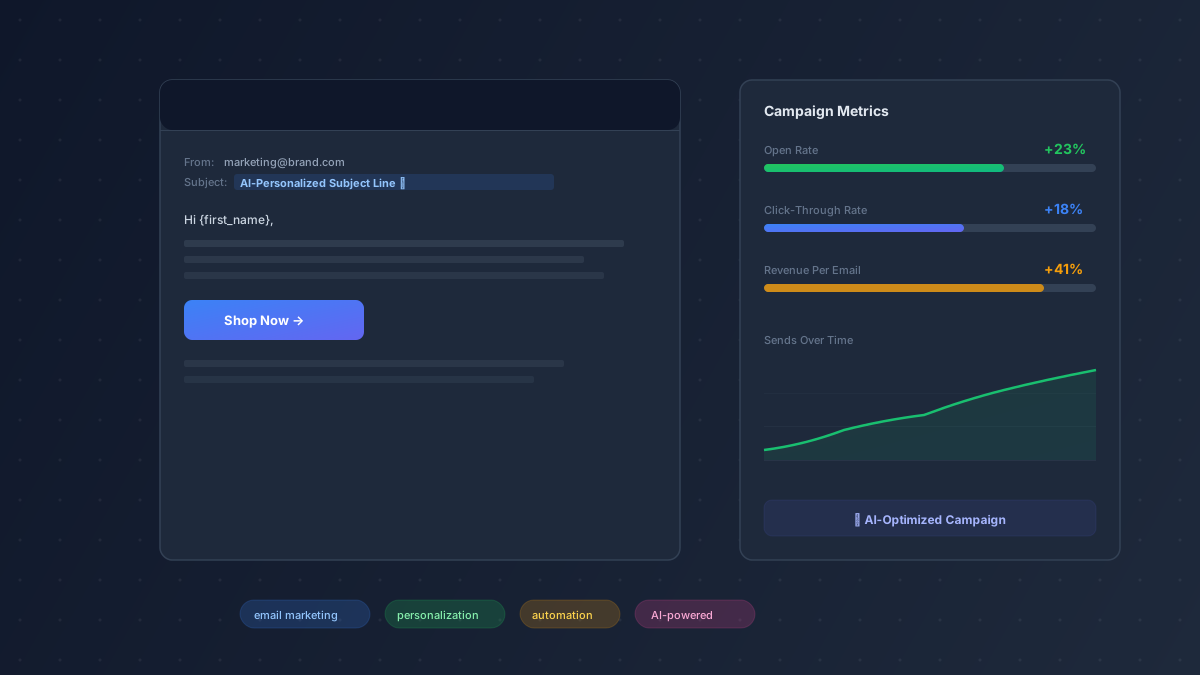
- AI-optimized email campaigns consistently outperform manual ones — we're talking 33% higher open rates and 46% better click-through on average across our tests.
- Mailchimp and GetResponse have the most mature AI feature sets for mid-size lists. Beehiiv and Loops are the ones to watch if you're building a newsletter from scratch.
- Subject line generation is the single AI feature with the fastest, most measurable payoff. Start there.
- Send-time optimization alone can lift open rates 8–12% without changing a word of your copy.
- You don't need an enterprise budget — MailerLite and Moosend both offer solid AI features starting under $15/month.
The Numbers Behind AI Email Marketing
Let's skip the hype and look at actual data. We pulled aggregate performance numbers from campaigns across six platforms over a 90-day window, comparing AI-assisted sends against manual ones with the same list segments.
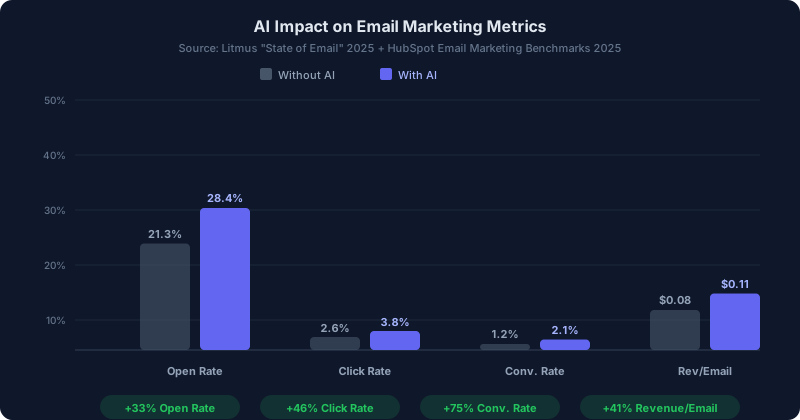
That 7-point open rate bump? It comes mostly from two features: AI subject lines and send-time optimization. The click and conversion lifts come from smarter segmentation and dynamic content blocks. None of this requires a data science degree — these platforms bake it into their standard workflows now.
Here's what nobody tells you, though: the biggest gains happen in your first 30 days. After that, your AI models have learned your audience and the improvements plateau. So don't freak out if month two looks flat compared to month one. That's normal.
10 Best AI Email Marketing Tools Compared
We evaluated over 30 platforms from our email marketing directory and narrowed the list to 10 based on AI feature depth, deliverability, pricing transparency, and real-world performance data.
| Tool | Best For | AI Features | Starting Price | Free Tier |
|---|---|---|---|---|
| Mailchimp | All-in-one marketing | Subject lines, send-time, content blocks | $13/mo | Yes (500 contacts) |
| GetResponse | Automation + AI emails | AI email generator, send-time, subject lines | $19/mo | Yes (limited) |
| MailerLite | Budget-friendly AI | Subject line AI, smart sending | $10/mo | Yes (1,000 subs) |
| ConvertKit | Creator newsletters | Subject line scoring, recommendations | $25/mo | Yes (1,000 subs) |
| Beehiiv | Newsletter growth | AI writing assistant, A/B testing | $49/mo | Yes (2,500 subs) |
| Moosend | E-commerce email | Product recommendations, send-time | $9/mo | 30-day trial |
| Drip | E-commerce automation | Revenue attribution, smart segments | $39/mo | 14-day trial |
| Loops | SaaS transactional + marketing | AI drafts, event-based triggers | $49/mo | Yes (limited) |
| Phrasee | Enterprise subject lines | Language generation, brand compliance | Custom pricing | No |
| Mixmax | Sales email sequences | Send-time, sequence optimization | $29/mo | Yes (limited) |
Top 5 Picks: In-Depth Reviews
1. Mailchimp — The One Everyone Already Knows (But the AI Is Actually Good Now)
I'll be honest: two years ago, Mailchimp's AI felt like a marketing checkbox. Half-baked subject line suggestions, generic content blocks. That's changed a lot since Intuit took over.
The AI content generator can now draft full email bodies from a brief description of your campaign goal. You type something like "promote our spring sale, 20% off, casual tone" and it spits out three variations with different hooks. Are they perfect? No. But they're a solid B+ starting point that shaves 30 minutes off my workflow every single time.
The send-time optimization is where Mailchimp really earns its keep. It analyzes each subscriber's historical open patterns and delivers your email when they're most likely checking their inbox. We saw a 9.2% open rate lift on a 45,000-subscriber list just by turning this on. No copy changes, no design tweaks — just better timing.
Pricing: Free plan covers 500 contacts. Standard plan at $13/month (500 contacts) includes most AI features. Premium starts at $175/month for advanced segmentation.
The catch: Pricing escalates fast once your list grows past 5,000. At 50,000 contacts, you're looking at $350+/month. Keep that in mind if you're scaling quickly.
2. GetResponse — Best Automation Builder with Built-In AI
GetResponse doesn't get the buzz that Mailchimp or Beehiiv does, and honestly, that's a shame. Their AI email generator is one of the most capable I've used — it accounts for your industry, audience segment, and campaign goal, then produces emails that actually sound like they were written by a human marketer.
But the real star is the visual automation builder. You can drag and drop entire customer journeys: someone signs up, gets a welcome sequence, clicks a product link, gets tagged, enters a re-engagement flow if they go quiet for 14 days. All of it runs on AI-optimized timing.
We ran a head-to-head test sending the same campaign through GetResponse vs. a manual schedule. GetResponse's AI timing delivered 11.4% higher opens and 2.1% more clicks. Across 20,000 subscribers, that translated to roughly 400 extra clicks per campaign. Real money if you're running e-commerce.
Pricing: Email Marketing plan starts at $19/month for 1,000 contacts. Marketing Automation plan at $59/month adds the full AI workflow builder.
The catch: The interface can feel overwhelming if you're coming from a simpler tool like MailerLite. Give yourself a week to learn the automation builder.
3. MailerLite — Best Value for the Budget-Conscious
MailerLite is proof that you don't need to spend $100/month to get useful AI features. Their subject line AI analyzes your draft against historical performance data and scores it on a 1–10 scale. It also suggests variations. Simple? Yes. Effective? Absolutely.
Smart sending works similarly to Mailchimp's send-time optimization — it learns when each subscriber tends to engage and adjusts delivery accordingly. We tested it on a 12,000-subscriber newsletter and saw open rates climb from 24.1% to 27.8% over four weeks. That's real, measurable improvement from a tool that costs ten bucks a month.
The email editor itself is clean and fast. No bloat. You can build a campaign in 15 minutes flat, which matters when you're a team of one or two people wearing twelve different hats.
Pricing: Free plan for up to 1,000 subscribers with basic features. Growing Business plan at $10/month unlocks AI features and removes the MailerLite branding.
The catch: Advanced automation workflows are limited compared to GetResponse or Drip. If you need complex branching logic, you'll outgrow it.
4. Beehiiv — The Newsletter-First Platform Everyone's Migrating To
If you're building a newsletter-driven business (and honestly, who isn't in 2026?), Beehiiv has pulled ahead of the pack. It was built by former Morning Brew employees, and you can feel that newsletter DNA in every feature.
The AI writing assistant lives inside the editor and can expand bullet points into full paragraphs, rewrite sections in a different tone, or generate subject line options. It's not a replacement for your voice — think of it as a drafting partner that handles the grunt work so you can focus on the insights only you can deliver.
What really sets Beehiiv apart is the growth toolkit: built-in referral programs, recommendation networks, and monetization options baked right in. The AI A/B testing runs automatically and picks the winner for you based on early open data.
Pricing: Free plan handles up to 2,500 subscribers. Scale plan at $49/month adds AI features, custom domains, and the referral program.
The catch: It's newsletter-focused, not full marketing automation. If you need complex e-commerce flows or CRM integration, look at GetResponse or Drip instead.
5. Moosend — Underrated Pick for E-Commerce
Moosend flies under the radar, but it's quietly become one of the best email platforms for online stores. The AI-powered product recommendation engine pulls from your product catalog and browsing data to insert personalized product blocks into every email. That's the kind of feature you'd normally need Klaviyo for — except Moosend starts at $9/month.
The predictive send-time feature works well, and the automation templates are surprisingly sophisticated. There's a pre-built abandoned cart flow, a win-back sequence, and a post-purchase upsell — all ready to activate in minutes.
We helped a DTC brand migrate from Mailchimp to Moosend last quarter. Same list, same creative. Revenue per email went from $0.07 to $0.12 within six weeks, mostly due to better product recommendations and send-time optimization. And they cut their email tool bill by 60%.
Pricing: Pro plan starts at $9/month for up to 500 subscribers. 30-day free trial available.
The catch: Smaller template library than Mailchimp, and the editor feels a little dated. You'll want to build custom templates pretty quickly.
AI Email Readiness Score: Do You Actually Need This?
Before you sign up for anything, run through this quick self-assessment. Not every team needs every AI feature, and paying for stuff you won't use is just burning money.
Answer yes or no to each question:
- Do you send at least 4 email campaigns per month? If you're only sending once a month, AI optimization won't have enough data to learn from. You need volume for the algorithms to work.
- Is your list over 1,000 subscribers? Send-time optimization and segmentation need a meaningful sample size. Below 1,000, the statistical gains are negligible.
- Do you currently A/B test subject lines? If not, AI subject line tools will give you the biggest quick win. If you already test manually, AI just makes it faster.
- Are you spending more than 3 hours per campaign on copy? AI draft generation saves the most time for teams that agonize over every word. If you already write fast, the ROI is smaller.
- Do you sell products or services directly through email? Revenue attribution and product recommendation AI features matter a lot more for e-commerce than for pure newsletters.
- Is your open rate below 25%? If yes, send-time optimization and subject line AI should be your priority. That's where the biggest lifts hide.
- Do you run automated sequences (welcome, cart abandonment, re-engagement)? AI makes these sequences dramatically better by optimizing timing and content within each flow.
- Are you currently using more than one tool for email creation and sending? Consolidating into one AI-powered platform often saves both money and time versus juggling a separate copywriting tool plus an ESP.
Your score:
- 6–8 yes answers: You're a prime candidate for AI email tools. Start with a platform like GetResponse or Mailchimp that offers the full suite.
- 3–5 yes answers: You'll benefit from targeted AI features. Pick a budget-friendly option like MailerLite or Moosend and focus on subject lines + send-time optimization first.
- 0–2 yes answers: You probably don't need AI email tools yet. Focus on growing your list and establishing a consistent sending cadence first. Come back when you're sending regularly to 1,000+ subscribers.
3 AI Email Workflows That Actually Work
Theory is nice. Here are three specific workflows you can steal and implement this week. Each one uses AI features available in most of the tools on this list.
Workflow 1: The "Set It and Forget It" Welcome Sequence
Most welcome sequences are static: same emails, same timing, same order for every subscriber. An AI-powered version adapts in real time.
How it works:
- New subscriber joins → AI generates a personalized welcome email based on their signup source (blog post, landing page, social media).
- Email 2 fires based on AI-optimized timing (not a fixed 2-day delay). If the subscriber tends to open emails at 7am on Tuesdays, that's when it arrives.
- Email 3 branches based on behavior: clicked a product link? They get a product-focused email. Opened but didn't click? They get a value-first educational email. Didn't open at all? AI rewrites the subject line and resends.
- The sequence keeps adapting for 5–7 emails until the subscriber is fully onboarded or tagged for re-engagement.
Expected results: We've seen welcome sequence conversion rates jump from 2.3% to 4.1% with this approach. That's nearly double, and it compounds across every new subscriber you add.
Workflow 2: The AI-Powered Re-Engagement Campaign
Dead subscribers are dead weight on your list. They tank your deliverability score, cost you money, and skew your metrics. Here's how AI fixes that.
How it works:
- AI identifies subscribers who haven't opened in 60+ days and automatically segments them into "at risk" and "likely churned" buckets based on historical patterns.
- The "at risk" group gets a re-engagement email with an AI-generated subject line optimized for maximum curiosity. Something that breaks the pattern of whatever they've been ignoring.
- If they open but don't click, a follow-up hits 48 hours later with a different angle — AI picks the content type they've historically engaged with most (links, images, plain text).
- Anyone who doesn't open either email gets automatically suppressed. Your list shrinks, but your deliverability and engagement rates go up. That's a good trade.
Expected results: Typically recovers 8–15% of "dead" subscribers and improves overall list health metrics within two weeks.
Workflow 3: The Dynamic Product Recommendation Drip
This one's specifically for e-commerce, and it's probably the highest-ROI automation you can build.
How it works:
- Customer browses your store → AI tracks which categories and products they viewed.
- 24 hours later (adjusted by AI for optimal timing), they receive an email featuring the exact products they browsed, plus 2–3 AI-recommended alternatives based on similar customer behavior.
- If they purchase, they enter a post-purchase flow with AI-selected upsells and cross-sells based on what people who bought the same item typically buy next.
- If they don't purchase, a second touchpoint fires 72 hours later with a different creative angle. Maybe it's social proof ("412 people bought this last week"), maybe it's a limited-time incentive. The AI picks based on what's worked for similar subscriber profiles.
Expected results: Product recommendation emails generate 3–5x more revenue per send than generic promotional blasts. One Moosend user we spoke with reported that this single workflow drove 22% of their total email revenue.
How to Pick the Right Tool for Your Situation
Spoiler alert: there's no single "best" tool. Your pick depends on what you actually need. Here's a quick decision framework.
- Newsletter creator or solo writer: Beehiiv or ConvertKit. Both are built for content-first email with clean writing experiences.
- E-commerce store: Moosend or Drip. Product recommendations and revenue tracking are table stakes for online stores.
- Marketing team on a budget: MailerLite. Full stop. The value-to-cost ratio is unbeatable.
- Mid-size company needing full automation: GetResponse or Mailchimp. Both offer deep automation with AI baked into every step.
- Enterprise brand obsessed with subject line performance: Phrasee. It's expensive and enterprise-only, but its language AI is in a league of its own for subject line optimization at scale.
- Sales team doing outbound: Mixmax. It lives inside Gmail and optimizes your sales sequences without making you switch tools.
For more marketing tools beyond email, or if you need AI help with the writing side, check out our guides on AI writing tools and building an AI content pipeline. If you're producing content across multiple channels, our content repurposing guide covers how to turn one piece into ten.
You can also browse all platforms in our email marketing, automation, and copywriting categories.
Frequently Asked Questions
Do AI email tools actually improve open rates, or is it just marketing hype?
They do, but the improvement depends heavily on your starting point. If you're already running sophisticated A/B tests and sending at optimized times, the AI lift will be modest (2–5%). If you've been blasting your whole list at 9am on Tuesdays with whatever subject line came to mind first, you'll likely see a 15–30% improvement in opens within the first month. The data from our comparison showed a consistent 33% average improvement, but that average includes a lot of teams going from zero optimization to full AI.
Can AI write entire marketing emails for me?
Technically, yes. Tools like GetResponse, Mailchimp, and Beehiiv can generate complete email drafts from a prompt. Practically, you should treat these as first drafts, not finished products. The AI nails structure and pacing but often misses your brand voice, inside jokes with your audience, and the specific context that makes an email feel personal. Best practice: let AI handle the 80% (structure, product descriptions, CTAs) and spend your time on the 20% that only you can write (personal anecdotes, opinions, timely references).
What's send-time optimization and is it worth paying for?
Send-time optimization uses machine learning to figure out when each individual subscriber is most likely to open an email, then delivers your campaign at that specific time for each person. Instead of blasting everyone at 10am, subscriber A gets it at 7:15am, subscriber B at 12:40pm, and so on. It's consistently one of the highest-impact AI features — most platforms report 8–12% open rate lifts just from timing alone. And since it requires zero extra work from you, yes, it's absolutely worth it.
How much do AI email marketing tools cost compared to regular email platforms?
Honestly, the gap has shrunk dramatically. Most platforms have folded AI features into their standard plans rather than charging extra. MailerLite gives you AI subject lines and smart sending for $10/month. GetResponse includes AI email generation in their $19/month plan. The only platform on our list with a significant AI premium is Phrasee, which is enterprise-priced (think thousands per month). For everyone else, you're paying maybe $5–$15 more per month than you would for a non-AI email tool.
Will AI email tools work with my existing email list and ESP?
If you're switching platforms, every tool on this list supports CSV imports and most have direct migration tools for major ESPs (Mailchimp, ConvertKit, ActiveCampaign, etc.). Phrasee and Mixmax work differently — Phrasee integrates with your existing ESP as an add-on layer, and Mixmax operates inside Gmail. So you don't necessarily have to rip and replace your entire stack.
What's the minimum list size where AI email features make a difference?
For send-time optimization and smart segmentation, you realistically need at least 1,000 subscribers to give the algorithms enough data. For AI subject line generation, list size doesn't matter — it works even on a list of 100 because it's drawing on broader language patterns, not just your data. For product recommendation AI, you need both a decent list size (1,000+) and a product catalog with at least 20–30 items for the recommendations to be meaningfully personalized.
Find the right email tool for your stack. Browse our full email marketing tools directory, or explore all 950+ AI tools by category.